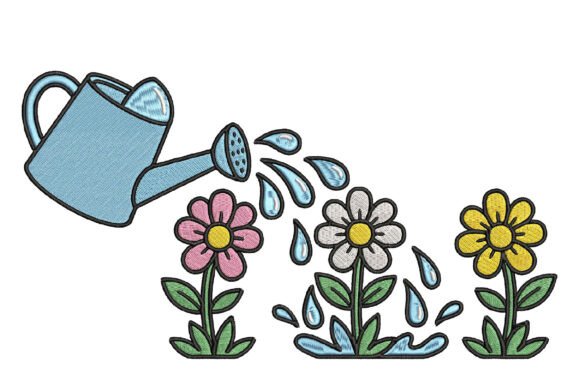
Watering Flowers Embroidery: A Business Design Review
As a professional embroidery designer who specializes in commercial branding and merchandise production, I approach every new machine embroidery design with a critical eye toward production viability. When evaluating the Watering Flowers Embroidery design for small business applications, my primary focus shifts beyond mere aesthetics to stitch integrity, brand alignment, and versatility across various substrates. This review analyzes how this specific motif performs when translated from a digital file into tangible assets like embroidered patches, staff uniforms, and retail merchandise.
Visual Personality and Brand Alignment
The first impression of the Watering Flowers Embroidery design is undeniably cheerful and approachable. Featuring a watering can pouring onto blooming flowers, it communicates growth, care, and freshness. For business owners, these visual cues are powerful. In the context of brand identity, this imagery works exceptionally well for florists, plant shops, organic bakeries, eco-friendly boutiques, and gardening services. It strikes a balance between playful and professional, avoiding the overly juvenile look that can sometimes plague floral motifs while maintaining a handmade warmth that mass-produced graphics often lack.
For an Etsy seller or a local creative studio, this design signals a connection to nature and nurturing. However, because it falls under the Single Flowers category, it possesses a distinct focal point that prevents visual clutter. This clarity is essential for small business merch where recognition must be instant. The design feels rustic yet refined, making it suitable for businesses aiming for a premium artisanal aesthetic rather than a corporate industrial look.
Performance Across Commercial Applications
In real-world commercial embroidery scenarios, versatility is key. A design might look perfect on screen but fail on a curved cap front or a textured canvas tote. Based on the composition of the Watering Flowers Embroidery, here is how I evaluate its performance across different business assets:
- Apron Embroidery: This is perhaps the strongest use case. Whether for a barista at a botanical-themed café or a florist arranging bouquets, the design sits perfectly on a chest pocket or centered bib. The vertical flow of the watering can and flowers complements the rectangular shape of most aprons without distorting.
- Tote Bag Design: Canvas totes are staples for handmade brands. The open space in this design allows for excellent registration on heavy canvas. Because the motif implies "carrying" or "nurturing," it aligns semantically with the function of a reusable shopping bag.
- Cap Embroidery: This requires caution. While the design is charming, cap fronts have limited vertical height. If the watering can handle extends too high or the water droplets fall too low, the design may need resizing or re-digitizing specifically for headwear to prevent hoop burn or distortion on the curved surface.
- Embroidered Patches: For uniform branding or collectible merch, this design translates well into patch form. The distinct outline of the watering can provides a natural border for merrowing or satin stitch edging. As a patch, it becomes a modular asset that can be applied to denim jackets, backpacks, or beanies, extending the reach of your design assets.
Technical Considerations for Production
A beautiful concept fails if the stitch density causes fabric puckering or needle breaks. When preparing this digital embroidery file for production, several technical factors demand attention. First, consider the interaction between the water droplets and the flowers. Small details like individual water drops can become problematic at reduced sizes. If you intend to use this as a small sleeve logo or a 2-inch patch, verify that these elements remain distinct and do not merge into a solid blob of thread.
Fabric texture plays a massive role in the final outcome. On smooth cotton twill or poplin, the Watering Flowers Embroidery will render crisply. However, on terry cloth towels or ribbed knits, the finer details of the flower petals may get lost. In these cases, using a heavier weight stabilizer or adding a topping is non-negotiable to maintain definition. Always match your hoop size to the design dimensions as closely as possible; excessive empty space in the hoop leads to shifting, which ruins the alignment of the pour stream against the blooms.
Thread colors also require strategic planning. While the design likely comes with suggested colors, business branding demands consistency. You may need to swap standard green thread for your specific brand’s Pantone match. Ensure there is sufficient contrast between the watering can, the water, and the flowers. Low-contrast combinations (e.g., light blue water on a white background) disappear in photography and from a distance, reducing the impact of your custom apparel.
Strategic Placement and Limitations
While versatile, this design has boundaries. Avoid placing it over seams, pockets, or plackets unless you have specialized hooping equipment and experience. The fluid nature of the water stream means the design has a directional flow; placing it upside down or sideways unintentionally can create visual confusion. Furthermore, be mindful of washing durability. If this design is destined for staff uniforms that undergo industrial laundering, ensure the satin stitches are secure and the fill patterns are dense enough to withstand abrasion. Delicate, decorative stitching meant for heirloom quilts may not survive the rigors of service industry wear.
For dark uniforms, test the design first. Light-colored threads on dark fabrics often require an underlay base to prevent the fabric color from bleeding through. This adds stitch count and density, which could alter the drape of lightweight garments. Always run a sew-out on the actual garment material before committing to a full production run.
Enhancing Value Through Professional Execution
Ultimately, the Watering Flowers Embroidery design is more than just decoration; it is a tool for building customer trust. High-quality execution signals professionalism. When a customer receives a handmade product featuring crisp, well-aligned embroidery, they perceive higher value. Conversely, poor registration or thread breaks suggest carelessness. To maximize buyer engagement, create a printable mockup or photograph a physical sample before listing items. This manages customer expectations and reduces returns.
Before purchasing or downloading, always confirm the licensing terms. Not all files allow for commercial resale or unlimited production. Verify that the embroidery file format matches your machine’s requirements (DST, PES, EXP, etc.) and check the included specifications for stitch count and dimensions. These details dictate whether the design fits your existing hoops and production timeline. By treating this design as a business asset rather than a casual craft project, you leverage its full potential to elevate your brand, unify your team’s appearance, and create merchandise that customers are proud to display.
Designer’s Pre-Production Checklist
- Test in Monochrome: Print or view the design in black and white to check value contrast independent of color.
- Verify Dimensions: Measure the design against your intended placement area (e.g., cap front vs. tote center).
- Stabilizer Selection: Choose cut-away for stretchy knits and tear-away for stable wovens; test both if unsure.
- License Audit: Confirm commercial usage rights specifically for the type of merchandise you plan to sell.
- Sample Sew-Out: Never skip testing on the exact fabric and stabilizer combination intended for the final product.